
In recent years, the Department of Economy and Business of Casa Asia has developed an important work of international project management, especially those promoted by the European Union, in order to channel the participation of economic agents, universities, centers of research, companies, etc., in programs of great interest to all those entities that wish to strengthen their links with the Asia-Pacific region.
European Program EU-Japan Region-to-Region Innovation Cooperation
It is a European Union project managed by Foreign Policy Instruments (FPI) and the Directorate-General for Regional and Urban Policy (DG REGIO) of the European Commission and implemented in cooperation with the Japanese Ministry of Land, Infrastructure, Transport and Tourism (MLIT). The main objective of the program is innovation cooperation between European regions and Japanese prefectures around the green transition (circular economy, clean energy, climate change and sustainable mobility), industrial transformation (digitization and social innovation) and demographic transition and competitiveness (public services and infrastructures in depopulated and aging regions). On the European side, the regions of Val d’Oise (France), Emilia-Romagna (Italy), the Basque Country (Spain), Ljubjana (Slovenia), Auvergne Rhône Alpes (France) and Catalonia (Spain) participate. Casa Asia, organizes as part of the EU-Japan R2R team.

Preparation of reports
The Delegation of the European Union in China has commissioned Casa Asia by the year 2020 to prepare a comparative report on regional innovation in the European Union and China, whose main objective is to analyze the policies of smart specialization (Regional Smart Specialization) in both regions The smart specialization strategy tries to take advantage of the strengths of each region in terms of innovation, so that it is innovated in those areas where there are competitive advantages due to the existence of a specific industrial fabric, research centers, etc. The study should establish a series of recommendations to cooperate effectively with China on innovation.
International Urban Cooperation Program www.iuc.eu
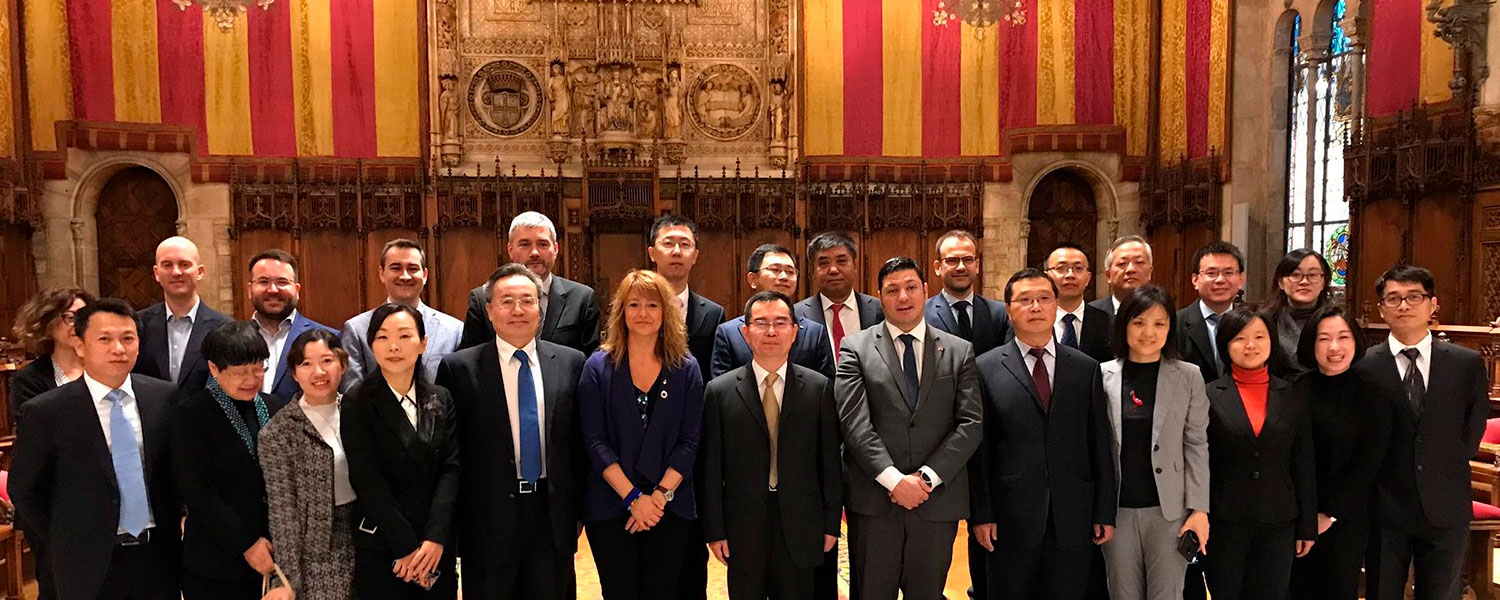
Casa Asia participates since 2017 in the International Urban Cooperation program of the Directorate General for Regional and Urban Policy (DG REGIO) dedicated to promoting urban cooperation with Asia on issues related to innovation in city management and sustainable development (conservation of biodiversity, energy efficiency, use of renewable energies, sustainable urban mobility, etc.). With this objective, missions of representatives of European companies and institutions have been organized to several Chinese cities, as well as the agendas of activities of several Chinese delegations that, within the framework of the program, visit the city of Barcelona, coinciding with the celebration of the Smart City World Congress.

World Cities Program www.world-cities.eu
Since 2015, Casa Asia participates in the “World Cities” program of the European Union aimed at international cooperation of European cities with Asian cities, through the Directorate General for Regional and Urban Policy (DG REGIO). The objective is to contribute to the exchange of good practices, successful experiences and share scientific and technological advances in the field. To this end, missions of representatives of companies and institutions from Barcelona to China and South Korea have been organized, and working sessions of delegations from China, Indonesia and South Korea with the respective European counterparts in the city of Barcelona.