


Air connectivity between Spain and Asia is at record highs, driven by new direct routes and a strong recovery in demand from Asia at Barcelona-El Prat and Madrid-Barajas airports.
Direct flights between Spain and Asia
1. Main connections from Barcelona
Josep Tarradellas Barcelona-El Prat Airport reached its largest ever network of direct flights to Asia this past summer. The flight network now includes nine routes operated by eight airlines to Beijing, Shanghai, Shenzhen, Hong Kong, Singapore, Seoul, and Baku. This expansion reinforces Barcelona's position among European airports with the most connections to Asia and broadens the options for tourists visiting Spain.
The Barcelona Air Route Development Committee (CDRA), comprised of the Catalan Government, the Barcelona City Council, the Chamber of Commerce, and Aena (the Spanish airport authority), has placed Asian connectivity among the priorities of its new 2026-2030 Strategic Plan. However, they also emphasize how the conflict between Iran and the United States creates uncertainty surrounding connectivity between Asia and Barcelona. Even so, one of their key strategies is to open up to Asia, especially India and Japan, countries that currently lack direct flights.
Air China offers the highest frequency, with up to 14 weekly flights to Beijing between July and September and seven to Shanghai starting in July. China Eastern operates ten weekly flights to Shanghai during peak season. These carriers are joined by Shenzhen Airlines, Cathay Pacific, Singapore Airlines, Asiana Airlines, T'Way Air, and Azerbaijan Hava, making the 2026 season much more diversified in terms of connectivity, destinations, and available flight frequencies.
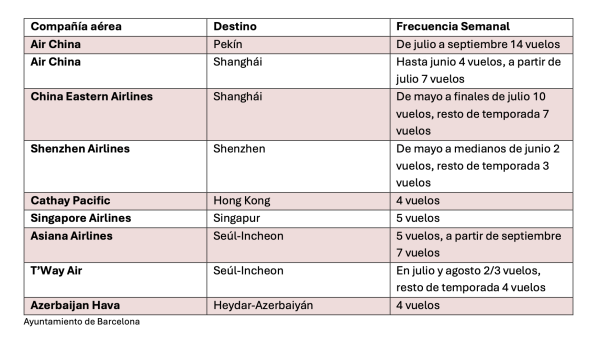
The connection to Seoul will undergo operational changes. Asiana Airlines flights will be gradually transferred to Korean Air as the integration of the two airlines progresses. Furthermore, the airline has informed the CDRA of its intention to increase flight frequencies in the future.
Studies by the CDRA estimate a potential demand of over 1,8 million passengers annually between Barcelona and various Asian markets that currently lack direct connections. This demand reinforces the growth prospects of the existing network and supports efforts to consolidate existing routes, increase their frequencies, and facilitate the gradual addition of new connections.
These connections are relevant for attracting high-spending visitors, attracting investors and facilitating air cargo for sectors such as pharmaceuticals, technology, fashion or fresh produce, which are key to the Catalan economy and its international projection.
2. Main connections from Madrid
Madrid's tourism sector is strengthening its air connectivity strategy with Asia with the opening of a new route to Singapore's Changi Airport, operated by Singapore Airlines with five weekly flights starting October 26th of this year. This new route, with an estimated economic impact of €265 million, will allow Madrid to attract high-end tourism from Asian markets and position itself as an airport hub for Southern Europe. This marks the airline's return to Madrid after a 20-year absence.
This route complements the plan undertaken by the Regional Government, the City Council, and IFEMA Madrid, within the framework of the public-private governance model “Madrid Turismo by IFEMA Madrid,” which has positioned the capital among the leading Asian tourism markets. Thus, the flights to Singapore join the existing direct routes to Tokyo. Furthermore, Madrid connects with nine destinations in China, such as Beijing, Shenzhen, and Wenzhou; one destination in Korea, Seoul; and, seasonally, with Bangkok, Thailand.
Asia is one of the most strategic regions for consolidating Madrid's high-quality tourism, thanks to its high-value, long-stay profile, which helps to reduce the seasonality of the destination. The numbers confirm this: visitors from Japan had the highest average spending per person in 2025 at €4.033, followed by those from China at €3.797, more than double the average.
Thanks to the extensive network of Singapore's Changi Airport, Madrid will be able to reach over 100 cities in Southeast Asia, Oceania, and the Indian subcontinent. Changi is the world's fourth busiest airport in terms of international seating capacity and offers direct connections to nearly 170 cities in more than 50 countries, with over 100 airlines operating weekly. Its connections to China, Indonesia, Malaysia, Australia, and India are particularly noteworthy.
Important countries without a direct connection to Spain
Direct air connectivity between Spain and Asia is concentrated mainly in Madrid-Barajas and Barcelona-El Prat, although there are differences between the two airports. Madrid has a more extensive network, with direct connections to destinations such as Tokyo, Seoul, Bangkok, and several Chinese cities. Barcelona, for its part, connects directly with major hubs such as Beijing, Shanghai, Shenzhen, Seoul, and Singapore.
One of the most notable differences is in the case of Japan. While Madrid has a direct connection to Tokyo, Barcelona currently does not have a nonstop flight to the country's capital. This situation can also be seen
with other major Asian markets. Neither of the two Spanish airports currently offers direct connections to India, Indonesia, Vietnam, Malaysia, or the Philippines, requiring at least one stopover for all of these. These are markets of great economic, demographic, and tourist importance, whose growing relationship with Spain is hampered by the lack of direct air links.
Positive effects of direct connections for tourism
Direct flights significantly facilitate travel between Spain and Asia and can greatly boost tourism. By eliminating layovers, travel time and complexity are reduced, making the destination more accessible and attractive to travelers.
Furthermore, improved connectivity can increase the number of tourists, both Asians visiting Spain and Spaniards traveling to Asia. It also facilitates the arrival of tourists from distant countries who, faced with the need for multiple layovers, might opt for other destinations with better connections.
On the other hand, direct flights can contribute to diversifying tourism, as they would facilitate year-round travel and thus generate a positive impact on the hotel, restaurant, retail, and cultural sectors.
facilitating their activity throughout the year.
In addition to boosting leisure tourism, direct flights help increase trade and investment flows between Asia and Spain. For airlines, customers attending trade fairs or traveling for business are especially important because they often travel in business class, where airlines have a much higher profit margin than in economy class.
Another important aspect for the profitability of direct flights is air cargo, so strengthening trade relations with Asia is crucial for the airlines to be profitable. Improving connections with new countries like India would help strengthen relationships at all levels.