

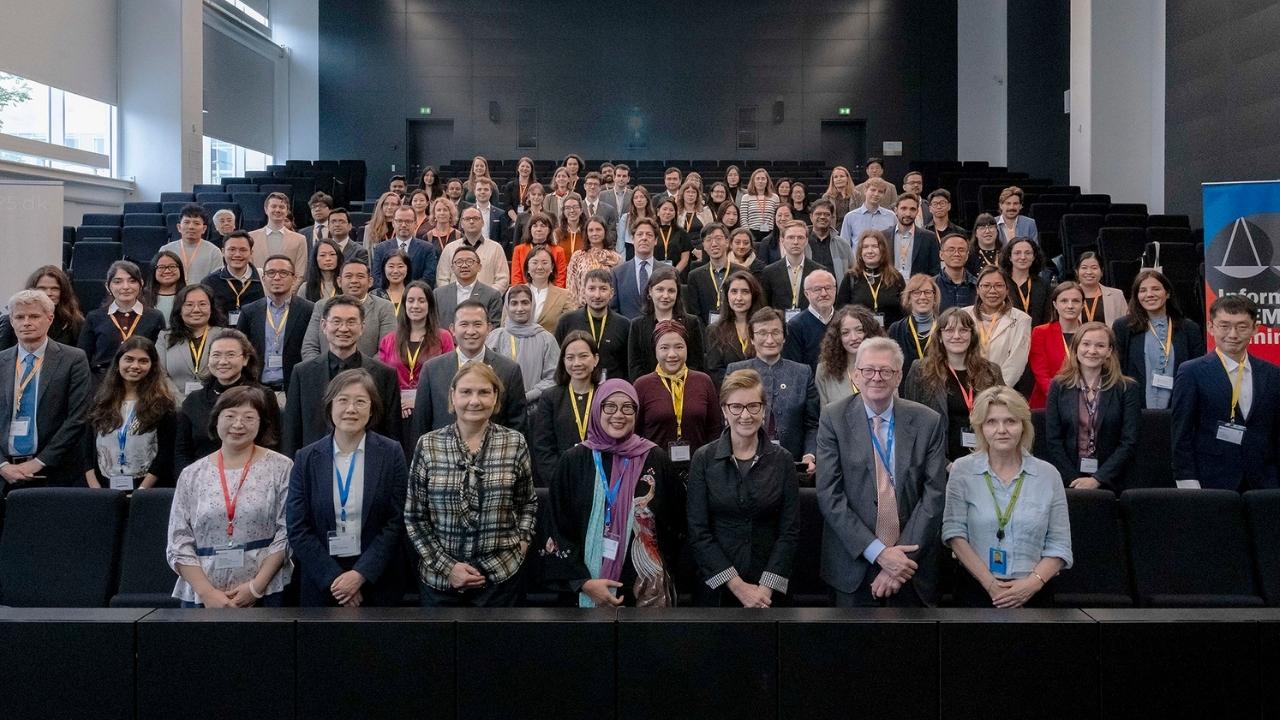
Artificial intelligence is transforming our societies at breakneck speed and posing unprecedented challenges to human rights, from privacy and non-discrimination to access to justice. From October 29 to 31, 2025, Copenhagen hosted the 23rd ASEM Informal Seminar on Human Rights, a space for dialogue between Europe and Asia in which institutional representatives, academic experts and civil society organizations participated. Casa Asia It was represented by Yasmin Paricio, coordinator of Policy, Society and Educational Programs, and the researcher Vicent CostaIn this chronicle, Costa shares the main reflections that emerged during the meeting. The publication also includes a video interview in which Costa analyzes the main challenges of global artificial intelligence governance.
Video
Chronicle of the 23rd ASEM Informal Seminar on Human Rights
By Vicent Costa
A framework for consensus: from context to action
Since its inception in 1997, the ASEM Informal Seminar on Human Rights (ASEMHRS) has established itself as a vital space for political and social dialogue between Europe and Asia. Organized by the Asia-Europe Foundation (ASEF), the Raoul Wallenberg Institute, and various foreign ministries, this forum brings together experts, civil society, and representatives from ASEM's 53 partners annually. In recent editions, the seminar has broadened its focus: from primarily addressing the situation of specific groups (such as people with disabilities in 2016), it has moved to tackle systemic global phenomena, such as the climate emergency in 2022 and poverty reduction in 2023. Thus, the 2025 edition, held from October 29 to 31 in Copenhagen, addressed an extremely urgent challenge: the intersection of human rights and the design and deployment of artificial intelligence.
Together with Yasmin Paricio, Coordinator of Policy, Society and Educational Programs in Casa AsiaI attended this meeting to represent Spain as an expert in artificial intelligence, with the aim of contributing a technical and scientific perspective to the definition of these new international standards.
The seminar, hosted by the Danish Ministry of Foreign Affairs and the University of Copenhagen, unfolded over three days designed to move from analysis to proposals. The work was based on a solid foundation: the Background Document prepared specifically for the seminar by Prof. Dr. Virginia Dignum, Dr. Rachele Carli, and Dr. Tang Yingxia. This document defines the three main themes of the seminar: privacy, equality and non-discrimination, and access to justice.
The first day of the seminar was dedicated to presenting the institutional framework and a diagnostic analysis of the topic. The sessions began in the Faculty of Humanities with a main session that served to compare regional perspectives. Speakers included Louise Holck (Danish Institute for Human Rights) and Kajsa Ollongren (EU Special Representative for Human Rights), along with academic experts such as Dr. Dignum herself and Dr. Tang Yingxia. Later, we attended the critical panel on artificial intelligence in the public sector, moderated by Rikke Frank Jørgensen. There, speakers such as Aysel Kucuksu, Karolina Iwanska, and Hafiz Noer debated the real tension between administrative efficiency and protecting citizens from automation.
The second day, focused on practical deliberation, formed the core of the event. The attendees divided into three working groups related to the main themes of the debate; the team of Casa Asia It was integrated into the second session (equality and non-discrimination), moderated by Dr. Sue-Anne Teo. The dynamic shifted away from keynote lectures to focus on technical analysis: we debated how to prevent algorithms from amplifying structural inequalities and what auditing mechanisms are viable to protect vulnerable groups, with special emphasis on the problems and opportunities that emerge from cultural, social, and economic exchange between the various countries of Asia, the Pacific, and Europe.
The final day focused on presenting a roadmap and future outlook regarding human rights and artificial intelligence. A highlight was the panel moderated by Dr. Gry Hasselbalch, which also included David Reichel (European Union Agency for Fundamental Rights) and experts such as Stanati Netipatalachoocote (University of Siam).
Beyond stereotypes: neither uniform nor opposing blocs
During the debates, the cliché of portraying Europe as a purely ethical-regulatory bloc and Asia as an innovator was considerably nuanced; in fact, viewing the two blocs as monoliths is an oversimplification that attempts to reduce thousands of cultural, political, and social realities to just two categories. Thus, while it is true that Europe stands out for the strength of pioneering binding frameworks such as the AI Act and the GDPR, which seek to establish a preventive and protective model, the Asian reality does not obliterate the regulatory framework either. Countries like Japan are already promoting concepts such as Society 5.0, explicitly putting technology at the service of public welfare, while other actors in the region are implementing strict regulations on recommendation algorithms and fake news.
The seminar's official conclusion reinforced this nuanced view and emphasized the importance and challenge posed by the unique characteristics of both regions: regulatory models cannot be directly transferred from one region to another. Thus, there was consensus that effective implementation requires cultural and institutional adaptation. Ultimately, the goal is not to impose the European model on Asia, or vice versa, but rather to achieve interoperability.
The regulatory dilemma and the necessary synchronization
One of the most critical points in the working sessions was the challenge of how to legislate for such a disruptive and rapidly evolving technology. In one of my interventions, I raised the dilemma of specificity. Indeed, we face a crossroads: if we draft a highly specific law, focused on today's technology, we risk almost immediate legislative obsolescence. By the time the law is published, the technology has already mutated, and the law is stillborn. If, on the other hand, we opt for very generic laws, attempting to achieve timelessness, we run the dual risk of them being so ambiguous that those developing artificial intelligence systems won't know how to comply with them, and those who must enforce the law won't know how to proceed.
But this dilemma is compounded by a third factor that, from my perspective, is just as crucial as the previous one: global asymmetry. The design, training, and deployment of artificial intelligence systems are inherently cross-border phenomena. A model designed in one country may be using data from another to help make decisions that affect the lives of citizens in a third. However, public policies tend to be local and fragmented.
For all these reasons, forums like this one in Copenhagen are vital. It's not about inventing new human rights, but about synchronizing political timelines between Europe and Asia-Pacific, ensuring the protection of individual dignity regardless of geographical location.
Tangible proposals to address the technical abyss
The official conclusions of the seminar include three mechanisms motivated precisely by the need to respond to the asymmetry and facilitate synchronization mentioned in the previous section.
First, the creation of an ASEM observatory on artificial intelligence and human rights was proposed. This body would not be a mere repository, but rather the institutional response to legislative obsolescence. Furthermore, it would serve as a real-time monitoring platform for sharing trends and best practices, enabling a more agile adaptation of regulations and overcoming the current fragmentation among regional blocs.
Furthermore, to combat the ambiguity of generic standards, the purchasing power of states was mentioned. Indeed, through public procurement, governments can require their technology providers to demonstrate compliance with specific ethical standards. In this way, by introducing non-discrimination or explainability requirements into technical specifications, abstract principles would be forced into verifiable metrics.
Finally, the importance of AI literacy as a democratic shield was emphasized, with the understanding that even the best regulations are useless without a critical civil society capable of identifying situations where the use of artificial intelligence systems violates human rights.
Inclusive transparency and justice in the face of collective harm
In the various discussions and debates held in our working group, I insisted, integrating a perspective that takes into account disability studies, that technical explainability is not enough: inclusive explainability by design is required, based on two key pillars.
On the one hand, linguistic inclusion, understood as the availability of explanations in the affected person's native language, is crucial compared to an explanation centered on the dominant language of technological development. We cannot forget that the ASEM space is not a monolith, but a vibrant mosaic with hundreds of languages and dialects that define a multitude of cultural identities. Ignoring this plurality would, in practice, leave part of the population of both regions in a situation of inequality.
On the other hand, cognitive and sensory accessibility requires that the explanation be understandable to people with low digital literacy, those in vulnerable situations, or those with specific needs. In fact, this lack of individual understanding of explanations generated by artificial intelligence systems becomes critical when we address justice in cases of collective harm.
Current legal systems are designed primarily for individual claims, while artificial intelligence systems often cause systemic harm to entire groups or society as a whole. The seminar's conclusions urge us to move beyond this fragmented model and design redress mechanisms that address these diffuse damages, protecting not only the individual but also the social fabric.
Lessons from Copenhagen between Asia and Europe
One cannot help but return from Copenhagen with a well-founded optimism. The seminar has served to solidify a truth that we often forget in the whirlwind of development: artificial intelligence is neither a force of nature nor a neutral tool; it is a socio-technical system that reflects, amplifies, or corrects the values of those who design it and of the systems in which it is deployed. Beyond the details of the proposals, what inspires hope is the shared sentiment glimpsed regarding the need for a joint and profound deliberation on the ethical aspects of a technology that seems to be developing and imposing itself rapidly and in every area of our daily lives.
In line with these impressions, the official conclusions of the meeting confirm this: ethical reflection, legal force, and public accountability must evolve in unison, always emphasizing proposals to build bridges between both regions. Ultimately, if we continue to prioritize transparency and the inclusion of underrepresented and vulnerable languages and groups, artificial intelligence will not replace our humanism; on the contrary, the magnitude of the challenge will compel us to be more human than ever before.
Highlighted
[1] Dignum, V., Carli, R., & Tang, Y. (2025, October). Background Paper: Human Rights and Artificial Intelligence. 23rd ASEM Informal Seminar on Human Rights, Copenhagen, Denmark. Asia-Europe Foundation (ASEF). https://asef.org/wp-content/uploads/2025/10/ASEMHRS23-Backgound-Paper.pdf
[2] Regulation (EU) 2024/1689 of the European Parliament and of the Council of 13 June 2024 laying down harmonised rules on artificial intelligence and amending Regulations (EC) No 300/2008, (EU) No 167/2013, (EU) No 168/2013, (EU) 2018/858, (EU) 2018/1139 and (EU) 2019/2144 and Directives 2014/90/EU, (EU) 2016/797 and (EU) 2020/1828 (Artificial Intelligence Regulation). (2024). Official Journal of the European Union, L, 2024/1689. https://eur-lex.europa.eu/eli/reg/2024/1689/oj
[3] Regulation (EU) 2016/679 of the European Parliament and of the Council of 27 April 2016 on the protection of natural persons with regard to the processing of personal data and on the free movement of such data, and repealing Directive 95/46/EC (General Data Protection Regulation). (2016). Official Journal of the European Union, L 119, 1–88. https://eur-lex.europa.eu/eli/reg/2016/679/oj
[4] Costa, V. (2025). Integrating a Disability Perspective into Lethal Autonomous Weapons Systems Analysis: First Steps. In: Sans Pinillos, A., Costa, V., Vallverdú, J. (eds) SecondDeath. Studies in Applied Philosophy, Epistemology and Rational Ethics, vol 76. Springer. https://doi.org/10.1007/978-3-031-98808-0_9
Vicent Costa is a tenured scientist at the Artificial Intelligence Research Institute of the Spanish National Research Council (IIIA-CSIC), a substitute professor at the Autonomous University of Barcelona (Bachelor's Degree in Artificial Intelligence and Bachelor's Degree in Philosophy), and a member of the Governing Council of the Catalan Association for Artificial Intelligence (ACIA). Costa also holds a degree in Philosophy, a degree in Mathematics, a master's degree in Pure and Applied Logic, and a doctorate in Cognitive Science and Language. His interdisciplinary research includes the study of logics for artificial intelligence, the design of explainable models of artificial intelligence, especially those that employ qualitative reasoning, and the analysis of ethical and philosophical issues related to artificial intelligence.
On these topics, Costa has published research articles and chapters in academic books, presented his research at national and international conferences, and received several awards (such as the Best STAIRS-ECAI 2020 Paper Award). He has previously conducted research stays at the Center for Spatial Cognition at the University of Bremen (Germany) and at the Singular Research Center for Intelligent Technologies at the University of Santiago de Compostela. He is also the coordinator of the editorial board of the journal NODES and received the 2022 ACIA First Prize for Best Popular Science Work in Artificial Intelligence for the book he co-authored with E. Senabre. How algorithms condition our vines (Sembra Llibres, 2021), and is the COO of Matesfácil, a website about teaching mathematics with more than 20 million visits per year.